United States / Virginia; imports from Asia and the Americas
Imported crab repacked as American: the Casey’s Seafood case
A U.S. seafood processor blended and repacked imported crab under a domestic-origin label. China was among several source countries—not the location of the proven labeling offense.
Federal conviction and sentencing2012–2015 scheme; 2018 charge; January 2019 sentence · Reviewed September 8, 2026
On this page
What the record establishes
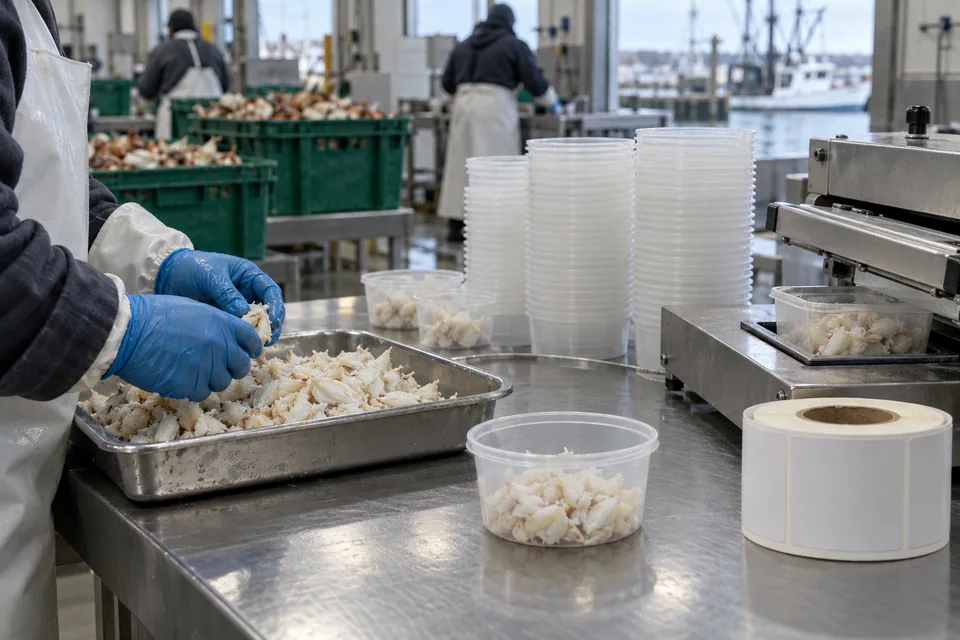
DOJ’s sentencing announcement describes a scheme at Casey’s Seafood to replace or blend domestic blue crab with imported meat from China, Indonesia, Thailand, Vietnam, and Central and South America. Employees repacked it under labels declaring U.S. origin.71
The contemporaneous sentencing bulletin reports that owner James R. Casey received 45 months in prison, three years of supervised release and a US$15,000 fine on 9 January 2019. DOJ described close to 400,000 pounds of falsely labeled crab meat across the scheme.70
The offense concerned false labeling by the U.S. business. Neither the charging nor sentencing announcement establishes that the foreign catch was illegally harvested or that all overseas suppliers knew about the domestic repacking scheme.6971
Why it matters
Following catch to market must include misconduct by buyers and processors in the Americas. Repacking can erase origin information after a lawful import and distort competition for local fishers. This case gives a concrete, adjudicated mechanism without making imported seafood itself synonymous with illegality.
The sequence
Origin labels falsified
DOJ describes imported crab repacked into domestic-origin containers.71
Charge announced
The criminal information identifies the repacking scheme.69
Owner sentenced
The contemporaneous bulletin records the 45-month term.70
Responses and legal posture
The sentencing sources describe the criminal outcome following the case. No additional defense statement is used, and the site does not transfer the U.S. processor’s conviction to unnamed foreign suppliers.7071
What remains unresolved
No full supplier-by-supplier chain is established. A later DOJ release about Michael Casey gives a different prison length for James; this file uses the contemporaneous sentencing bulletin. The sentence is a historical outcome, not a claim about current custody or current company operations.
China is one of several reported product-source countries. The established conduct was by a U.S. processor; no Chinese government or supplier complicity is established.
How to read the evidence labels →Sources for this file
Owner of seafood company sentenced to prison for blue crab scam ↗
James Casey, false origin labels, source countries and volume
Source limits
U.S. processor’s offense; does not establish foreign suppliers knowingly participated or the catch was illegally harvested.
Environmental Crimes Section Monthly Bulletin, February 2019 ↗
United States v. James R. Casey, 4:18-cr-00004
Source limits
Reports 45-month sentence; a later release about a different defendant says 48 months. This file uses the contemporaneous sentencing bulletin.
Owner of seafood company charged in Atlantic blue crab scam ↗
Imported sources and repacking allegations
Source limits
Initial allegations; later sentencing establishes the outcome. Imported origin alone is not illegal.